
Growing Business Challenges
Executive Summary
Growing SMBs usually do not hit an operational wall because demand suddenly turns bad or because people suddenly become less capable. They hit it because the coordination model that worked at five employees becomes fragile at fifteen, thirty, or multi-channel scale: the owner becomes the routing hub for decisions, critical know-how lives in people’s heads and inboxes, spreadsheets multiply without clear ownership, and “heroic” effort keeps service levels looking better than the underlying operating system really is. Across firm-level and policy research, SMEs use fewer formal management practices than larger firms, yet those practices are consistently associated with stronger growth, productivity, profitability, and survival; importantly, the return to formalization tends to rise with firm size, which helps explain why informality is often rational early and risky later. [1]
The wall usually shows up first as operational pain, not as a strategic memo. Quotes slow down because approvals bottleneck. Inventory, finance, and customer records disagree because the business has more than one partial truth. Staff spend more time checking, chasing, exporting, and reconciling. Customers may still get a good experience, but only because someone important is manually stitching the process together. Official CRM guidance aimed at growing firms explicitly makes this point: manual tracking may be feasible for a handful of customers, but not for dozens or hundreds; even spreadsheet-based CRM templates are positioned as a temporary tool for the first 25–50 active relationships, after which manual updates become a drag on growth. [2]
The analytical implication is important for the article you plan to write: this is not fundamentally a software-sales story. It is an organizational-design story. Software becomes useful only when the business also clarifies decision rights, chooses systems of record, documents recurring workflows, captures tacit knowledge, and adds light but real governance around approvals, data quality, and accountability. Repeatable workflows, single sources of truth, and internal controls are what make the business more transferable, more resilient, and less owner-dependent. [3]
Why the wall appears
The operational wall is best understood as a stage transition. Classic growth-stage research argues that as small businesses develop, they move through distinct stages, and transitions are usually accompanied by crises that require changes in management approach rather than just more effort. More recent SME research reaches a similar conclusion: growing firms face a broad mix of leadership, people, and business-model challenges, and growth tends to stall when those challenges are addressed narrowly instead of in balance. [4]
The reason early informality survives for as long as it does is that it is often economically sensible in the beginning. notes that managerial skills and management practices matter for SME productivity, but also that informal management can be a rational choice in smaller firms and that the return to formal practices tends to rise with size. then adds the crucial empirical point: SMEs are less likely to use formal management practices than larger firms, but those that do use them tend to grow faster and become more productive. In other words, the same informality that is efficient at low scale becomes a liability once coordination demands exceed human memory and owner bandwidth. [5]
The chart below is a synthesis of the stage-of-growth literature and SME management evidence: in many growing SMBs, commercial growth rises steadily, while operating complexity accelerates sharply once team handoffs, channels, product variants, and approvals multiply. The wall appears when complexity rises faster than process maturity. [6]
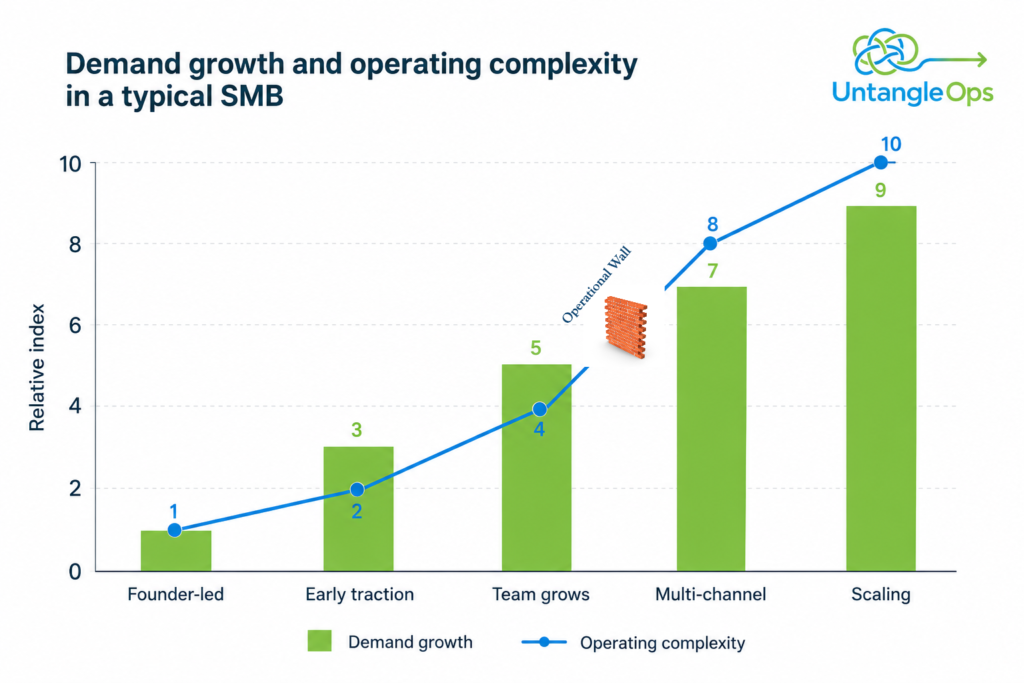
A practical diagnostic is this: if quoting, onboarding, invoicing, fulfillment, collections, and reporting still “work,” but only because people constantly chase status across email, chat, and memory, the business is not operating smoothly; it is operating on hidden subsidies of attention. That is exactly the pattern described in multiple case studies of firms that outgrew disconnected tools and manual coordination. [7]
Short-term, the best response is not a big transformation program. It is a diagnostic reduction: map the five workflows that create or protect the most value; mark where approvals queue, where data is re-entered, where exceptions pile up, and where only one person knows what to do. Long-term, the answer is to formalize only what needs repeatability, transferability, and cross-functional clarity, then let tools reinforce that operating model. [8]
Owner-as-bottleneck dynamics
The owner bottleneck emerges when the founder remains the default router for decisions, context, and exceptions. Early on, that can be a strength: a founder sees the whole business, knows customers intimately, and can improvise quickly. But the same design becomes capacity-constrained as the company grows. A widely cited entrepreneur survey by found that among 143 CEOs on the Inc. 500 list, those with high delegator talent reported faster growth, greater revenue, and more job creation than peers with lower delegation capacity. makes the same managerial point more plainly: as responsibilities become more complex, the difference between leading and merely doing becomes painfully visible. [9]
This does not mean every owner-managed firm is weak. The NIESR evidence notes that the relationship between owner-management and management quality is mixed. The better risk marker is not “founder present,” but rather decision rights still concentrated, tacit knowledge still concentrated, and formal management practices still underdeveloped. That is when growth starts queueing behind one person’s calendar and cognitive bandwidth. [10]
A useful way to visualize the pattern is as an information-flow problem. In a founder-centric operating model, disparate requests and exceptions all converge on the same person. The business keeps moving, but the queue lengthens, decisions become batch-processed, and the owner becomes both the quality-control layer and the point of failure. This flowchart is a synthesis of the delegation evidence and owner-led case examples. [11]
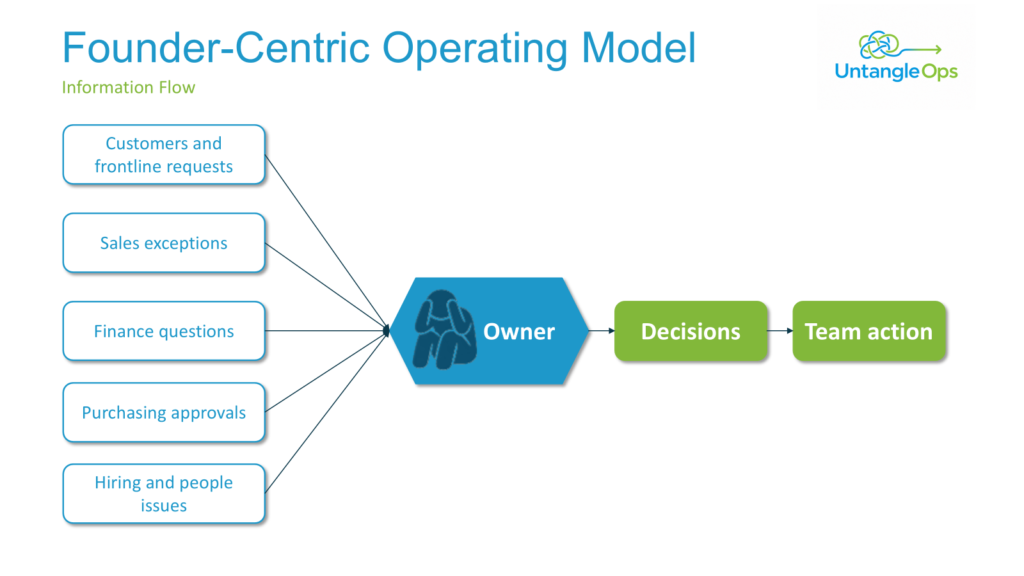
The AP-reported small-business examples are telling. One founder of a roughly 40-person media company described the emotional difficulty of giving up tasks but recognized the company could not keep expanding if he kept books and monitoring work personally; another PR-firm owner admitted he had long believed he alone had the answers, until retention and customer experience suffered enough that he had to change. Those are not software problems. They are classic owner-as-bottleneck dynamics. [12]
In practice, the signs are easy to spot: pricing exceptions, discounts, refunds, vendor approvals, hiring decisions, customer escalations, and even routine reporting requests all wait for the owner; staff members seek permission on reversible decisions; managers cannot answer cross-functional questions without “checking with the founder”; and the owner becomes the only reliable integrator of sales, ops, and finance reality. [11]
The short-term fix is to reduce owner decision load, not owner standards. Set approval thresholds by value and risk, create default rules for common cases, and institute a weekly decision review so recurring exceptions become policy instead of repeat interruptions. The long-term system change is to assign named process owners, define decision rights clearly, and replace “ask the owner” with dashboards, standard work, and operating cadences that let managers act without improvising around uncertainty. [13]
Tribal knowledge and single points of failure
Tribal knowledge becomes dangerous when the business relies on experience that has never been converted into a shareable operating asset. The official ISO guidance on organizational knowledge is particularly useful here: it states that document control alone is not enough for tacit or experience-based knowledge, and it explicitly points to mentoring and succession planning as ways to capture knowledge that otherwise exists only in people. In parallel, IRS internal-control guidance treats segregation of duties as fundamental and warns that weak controls increase risk. Put simply, if one person carries essential know-how and also performs or approves the key transaction, the business has both a knowledge-risk problem and a control-risk problem. [14]
A strong SMB-focused example comes from a small ecommerce retailer case study in which the team managed cash, stock, and bank accounts across multiple spreadsheets. Because the spreadsheets depended on macros, the owners found them difficult to understand, and if a single entry was missed the reporting system could “go haywire” and take a long time to debug. Another operations testimonial described a business suffering “major disconnects between inventory and finance” before it unified its process. In both cases, the fragility was not just in the tool; it was in the fact that understanding was concentrated and reconciliation was manual. [15]
The empirical lesson is broader than those examples. ISO’s guidance says organizational knowledge has to be determined, made available, preserved, protected, and refreshed; IRS guidance adds that organizations need separate authorizations, executions, and recordings if they want transaction integrity; and NIST’s risk framework emphasizes disciplined, repeatable, continuously monitored processes. That combination is exactly what tribal-knowledge-heavy SMBs lack. [16]
A business has a tribal-knowledge problem when vacations create panic, onboarding depends on shadowing one person, nobody can explain how a number in a report was produced, and a process cannot be completed without “the person who really knows how it works.” A related control warning sign is when the same individual authorizes, executes, and records a sensitive transaction because the team is “too small” to separate those roles. [17]
The short-term fix is to build a single-point-of-failure register: list the top processes, name the only people who know them, record the artifacts they use, and create backups. Record short SOPs, screen captures, checklists, and reconciliation rules; cross-train at least one second operator for every critical process; and add backup approvers. The long-term system change is to convert tacit knowledge into routine operating infrastructure: documented workflows, role-based permissions, systemized approvals, and a continuity plan that assumes key-person absence is a normal risk, not an exceptional one. [16]
Why everything works until it doesn’t
One of the most important analytical points is that informal systems often look better than they are for quite a while. Research on spreadsheet errors and decision-making explains why. In field interviews with executives and senior managers, respondents almost universally reported spreadsheet errors as common, yet significantly fewer said those errors led directly to bad decisions because “human-in-the-loop” processes often mitigated the consequences. Quality control, however, was usually informal, and a meaningful minority believed those ad hoc checks were sufficient. That is the essence of the “everything works… until it doesn’t” failure mode: constant human patching delays visible failure but does not remove the underlying fragility. [18]
This pattern becomes more dangerous as volume and coupling increase. Early-stage informality can be rational, as OECD notes, because the fixed costs of formal systems may outweigh the benefits when scale is low. But once a business adds more customers, products, locations, sales channels, or compliance requirements, the number of handoffs and exceptions rises faster than the informal repair capacity of the people doing the work. At that point, one missed update, one absent employee, or one delayed approval can turn a manageable workaround into a chain failure. [19]
The case evidence is highly consistent. A commerce case study describes a business whose wholesale process relied heavily on email ordering and outdated apps; as cross-border complexity rose, the process started creating missed opportunities and sales inefficiency. A travel company case study describes a customer team relying on emails, reminders, spreadsheets, and documents, with some basic email broadcasts taking up to four hours because data had to be exported, cleaned, and segmented manually. A scale-up case study describes a company that outgrew manual spreadsheets and mixed tools as it expanded from 40 customers to more than 1,200 organizations, making alignment and responsive service harder to sustain. [20]
The spreadsheet research adds technical credibility to that operational story. says large spreadsheet models are very likely to contain at least one incorrect bottom-line value, errors are difficult to detect, and developers are often overconfident in accuracy. is more cautious on exact cell-error rates, but it still found that 86% of the operational spreadsheets they audited contained errors, while earlier audit summaries had put the share at 94%; the spread in estimates reflects differing definitions and methods, not safety. The rigorous conclusion is not “all spreadsheets are useless.” It is that informal analytical infrastructure becomes risky when the business starts depending on it for core operations. [21]
The practical signs are familiar: urgent end-of-month cleanup, inventory/finance mismatches, recurring “just this once” exceptions, slow turnaround on simple customer requests, heavy use of exports and CSV cleaning, and frequent rework that disappears because a capable employee quietly fixes it before it reaches the customer. [22]
The short-term fix is to stop treating repeated exceptions as random. Classify them, count them, and ask which ones recur often enough to deserve a rule or automation. Establish one authoritative record for each critical domain, and require process owners to resolve root causes instead of adding one more workaround tab, inbox rule, or “final_FINAL_v7” spreadsheet. The long-term system change is to build integrated workflows around master data, standard approvals, automated routing, and measurable exception handling. [23]
From person-built workarounds to scalable systems
The core distinction is between processes built around people and processes built around systems. A workflow, in IBM’s definition, is a repeatable sequence of tasks, and workflow-management software routes work to the right person with the right information at the right time. ERP systems are designed to provide a unified view and a single source of truth across finance, supply chain, procurement, and operations. CRM systems centralize customer history and enforce more consistent lead, account, and service handling. The benefit is not abstraction for its own sake; it is that the business can operate with less dependence on memory, inbox archaeology, and manual coordination. [24]
There are also concrete signs that a business has outgrown spreadsheets and workarounds. The official HubSpot spreadsheet CRM template is positioned for the first 25–50 customers, roughly the first two to six months, and estimates one to two hours per week of manual maintenance at that scale; beyond 50 active relationships, the guide warns that manual updates become time-consuming. HubSpot’s CRM implementation guide says manual tracking may be feasible for five customers, but not for 50 or 500. Real-world case studies then show the operational expression of that threshold: multiple spreadsheets updated per transaction, manual CSV exports, disconnected booking and marketing systems, and hours lost preparing what should be routine communications or reports. [25]
The comparison below is directional rather than universal pricing advice. It synthesizes official template/setup examples, partner quick-start offers on Microsoft’s marketplace, Microsoft pricing pages, and official guidance on workflow, CRM, ERP, internal controls, and risk management. [26]
| Tool pattern | Typical direct cost | Typical time to implement | Dominant failure modes | Scalability | Data integrity | Required governance |
| Spreadsheets | Very low | Hours to days | Formula errors, hidden logic, version conflicts, manual re-entry, key-person dependence | Low | Low to moderate | Low formal governance, but high hidden reliance on disciplined individuals |
| Email and chat approvals | Very low | Immediate | Lost context, untracked approvals, inconsistent decision criteria, no audit trail | Low | Low | Minimal formal governance unless wrapped in strict rules |
| Ad-hoc point tools | Low to moderate subscription cost | Days to weeks | Duplicate records, integration drift, conflicting definitions, brittle handoffs | Moderate | Moderate | Moderate governance around ownership and integration |
| CRM | Low to moderate for SMB cloud setups | Days to weeks | Poor adoption, unclear lead/account ownership, bad field design, weak data migration | Good | Moderate to high | Clear ownership rules, training, data standards, review cadence |
| Workflow automation | Low to moderate per user or bot | Days to weeks | Broken connectors, poor exception handling, invisible automations, weak change control | High for repetitive flows | High when tied to source systems | Process mapping, logging, change control, exception monitoring |
| ERP | Moderate to high | Weeks to months | Scope creep, bad master data, weak process design, poor cross-functional adoption | Very high | High | Strong governance, master-data discipline, role clarity, testing, training |
The most important interpretive point is that scalable systems demand more governance, not less. CRM implementation guidance explicitly requires a needs assessment, workflow mapping, lead ownership rules, data migration, testing, and training. IRS guidance says segregation and controls are fundamental. NIST frames risk management as repeatable and continuously monitored. So the genuine upgrade path is not “replace Excel with software.” It is “replace tacit coordination with designed coordination, then let software enforce and accelerate it.” [13]
That is why the best short-term move is usually a systems-of-record decision rather than a platform shopping spree. Decide where customer truth lives, where order truth lives, where inventory truth lives, and where cash truth lives. Standardize required fields. Freeze the proliferation of rogue trackers. Then automate only the highest-volume, highest-repetition handoffs first. Long-term, build a phased architecture: transactional backbone, customer system, workflow layer, reporting layer, and governance layer. The benefits of data-driven decision-making appear especially meaningful for smaller, single-unit firms when the data is actually structured and usable. [27]
The credibility effect and hidden fragility
What you called the credibility effect is a strong and under-discussed idea, and the best evidence suggests it is real even if the label itself is an analytical synthesis rather than a formal research term. The mechanism is this: visible confidence and visible responsiveness create a perception of competence, and that perception can remain high even when the underlying operating model is brittle. The urlBehavioral Science & Policy review on leadership and overconfidenceturn22search15 argues that expressions of confidence increase credibility and support, even when confidence exceeds what the facts justify. makes the operational version of the same point: the continued presence of heroes should worry leaders because it signals a system failure, not just admirable effort. Caulkins’ spreadsheet fieldwork shows the same masking effect at the process level: people often believe informal human review will catch major issues, which can postpone visible failure. [28]
In SMBs, this effect is often strongest when the founder is genuinely excellent. A brilliant owner can remember customer preferences, resolve exceptions instantly, catch data inconsistencies by feel, and reassure everyone with confident judgment. That makes the business appear highly competent—and, in a sense, it is. But the competence is lodged in scarce people rather than in the operating system. The result is a dangerous mismatch between observed performance and transferable capability. The SBA’s own small-business programming frames this directly: building scalable systems and reducing owner dependency are essential if the business is to grow, run smoothly without the owner’s constant presence, and become a more valuable, resilient asset. [29]
A business is likely under the spell of this credibility effect when customers praise responsiveness but the team can only sustain that responsiveness through overtime; when meetings celebrate heroics more than process reliability; when managers are confident but cannot produce clean cycle-time, backlog, or error-rate data; and when everyone says the business is “fine” as long as a few specific people stay available. [30]
The practical answer is to measure system competence, not just person competence. Track cycle time, queue length, rework, reconciliation breaks, service variability, and exception volume. Run an owner-absence test. Ask what fails if one key operator disappears for two weeks. Replace praise for firefighting with visibility on prevention. And insist on honest uncertainty: confidence that is untethered to reality may preserve morale briefly, but it undermines resilience and planning over time. [31]
Checklist and sources
Short actionable checklist for SMB owners
- List the ten decisions that still require you personally, then set thresholds and default rules so at least half of them can be delegated safely within 30 days. [32]
- Build a single-point-of-failure register: for each critical workflow, name the only person who knows it, the tools they use, and the backup you would rely on tomorrow. [16]
- Choose one system of record each for customers, orders, inventory, and cash; stop maintaining parallel truths unless there is a documented reconciliation owner. [33]
- Document the five recurring workflows that matter most to revenue and cash flow: quote-to-order, order-to-cash, procure-to-pay, customer issue resolution, and month-end close. [34]
- Add minimal but real controls: separate authorization, execution, and recording where possible, and review exceptions weekly. [35]
- Automate one high-volume handoff first, not ten low-volume annoyances. Pick the flow with the most re-entry, chasing, or avoidable delay. [36]
- Track operational health with a small dashboard: queue time, rework, backlog, reconciliation breaks, missed follow-ups, and owner escalations. [37]
- Run a no-owner or no-key-person test for one week. If the business slows dramatically, you have found the next system you need to build. [38]
Complete our Comprehensive Checklist Here
Selected sources
- — UK evidence that SMEs use formal management practices less than larger firms, but benefit in growth and productivity when they do. [10]
- — useful on why managerial skills, management practices, ICT, and networks affect SME productivity, and why informality can be rational at small scale. [39]
- — broader evidence linking management capability to productivity, profitability, and survival. [40]
- — qualitative study of 44 SMEs identifying growth challenges across leadership, people, and business model. [41]
- — survey evidence connecting delegation capacity with growth, revenue, and job creation. [42]
- — concise synthesis connecting delegation with productivity, morale, and growth; especially useful for owner-bottleneck framing. [43]
- — official guidance on tacit knowledge, documentation limits, mentoring, and succession planning. [44]
- — practical official language on segregation of duties, control weakness, and transaction integrity. [45]
- — official framework for repeatable, documented, continuously monitored risk management. [46]
- — authoritative review arguing large spreadsheets are likely to contain errors, errors are hard to detect, and users are often overconfident. [47]
- — audit-based review that tempers sensational claims while still finding high error incidence in real operational spreadsheets. [48]
- — especially useful for the “human in the loop” masking effect and informal quality control. [49]
- — official explanation of ERP as a unified operational system and single source of truth. [50]
- — official guidance on centralized customer data, sustainable growth, and implementation basics. [51]
- — useful for practical thresholds showing when spreadsheet-based customer management starts to break down. [52]
- — useful because it shows that system change requires ownership rules, migration, testing, customization, and training. [53]
- — helpful official definition of repeatable workflow and workflow management. [54]
- — official workflow-automation pricing and trial information, useful for relative cost comparisons. [55]
- — official marketplace example of SMB-oriented CRM quick-start timing and scope. [56]
- — official marketplace example of ERP quick-start timing and pricing for firms moving beyond entry-level finance tools. [57]
- — useful official framing for owner dependency, scalable systems, and transferability. [58]
- — strong conceptual support for the idea that repeated heroics signal system failure. [59]
- — useful support for the idea that displays of confidence create credibility even when they can be misleading. [60]
Tags:
operational bottlenecks
growing business challenges
owner bottleneck
business scalability
tribal knowledge risk
business process improvement
operational maturity
SMB growth problems
scalable operations
outgrown spreadsheets
process standardization
business systems and processes
Written By: UntangeOps Specialist Team
Published On: 15 May, 2026
Updated On: 3 June 2026
Let’s Untangle YOUR Operations
We have a proven methodology and can replicate our success for your organization. Easy.