
Operational Insights for Growing Businesses
Practical articles on operational scaling, process design, business systems, and organizational efficiency for small and mid-sized businesses.
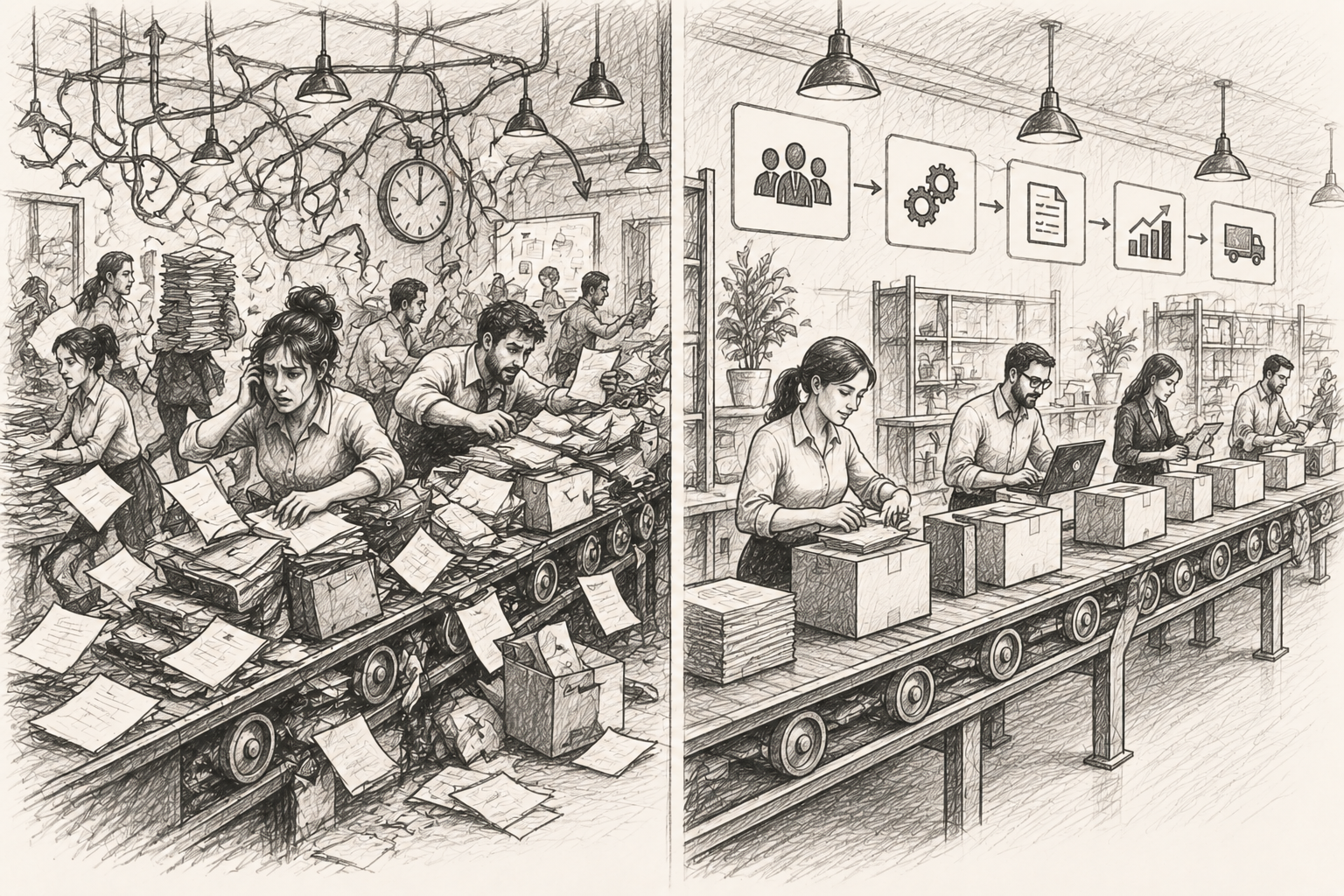
As businesses grow, operational complexity often grows faster than structure. What once worked through spreadsheets, workarounds, and tribal knowledge can eventually lead to bottlenecks, firefighting, and inconsistent execution.
These articles explore the operational challenges that growing businesses commonly face — and the systems, processes, and organizational thinking that help create scalable operations.
-
Best For: Owners, Founders, CEOs and Leadership Teams in Growing Small and Mid-Sized BusinessesReading Time: 25-30 minDepth: Entry-LevelRead more: Operational Due Diligence When Buying a Business
The Business Looked Great on Paper. Then We Looked at How It Actually Worked. The salon was busy: twenty-two chairs, approximately $2.5 million in annual revenue, an established team, a loyal customer base, and three owner-partners who had spent years building the business. From a financial perspective, there was plenty to like. A potential buyer had already begun working through the usual acquisition process. Accountants were reviewing the numbers, legal advisors were examining the transaction, and the company’s financial history, assets, contracts and obligations could all be analyzed in the conventional way. We were brought in by the buyer to…
-
Best For: Owners, Founders, CEOs and Leadership Teams in Growing Small and Mid-Sized BusinessesReading Time: 8-12 minutesDepth: Entry-LevelRead more: What Is a Fractional CIO?
Practical technology leadership for growing businesses—without the cost of a full-time CIO. What Is a Fractional CIO? 7 Signs Your Business Needs CIO-Level Technology Leadership Executive Summary Your business may not need a full-time CIO. But it may already need CIO-level thinking. As small and mid-sized businesses grow, their technology environment usually grows with them. New software gets added. Departments choose different tools. Vendors multiply. Reporting becomes more complicated. Cybersecurity becomes more important. And critical business processes become increasingly dependent on systems that may never have been designed to work together. Eventually, technology stops being simply an IT issue. It…
-
Best For: Business Owners, Founders, Family Businesses, Buyers and EntrepreneursReading Time: 10 -15 minutesDepth: Entry-Level/IntermediateRead more: What buyers look for in businesses for sale
Preparing Your Business to Perform Beyond the Current Owner What Buyers Look for in Businesses for sale Executive Summary If you are thinking about selling your business in the next few years, you have probably wondered what it is worth. But there is another question that is just as important: What will a buyer actually see when they look inside the business? A profitable company can still be difficult to sell if it depends heavily on the owner, has poorly documented processes, unreliable reporting, outdated systems, or important knowledge that exists only in employees’ heads. Conversely, a business that is well…
-
Best For: Owners, Founders, Operations Managers, Growing SMBs (10–100 Employees)Reading Time: 10 -20 minutesDepth: AdvancedRead more: When Is the Right Time to Invest in Better Systems?
Growing Business Challenges – Systems When Is the Right Time to Invest in Better Systems? Executive Summary The right time to invest in better systems is usually after operational friction becomes repeatable and measurable, but before it becomes a credibility problem. In practice, that means moving when the same bottlenecks keep reappearing across handoffs, staff are building spreadsheet workarounds, management spends too much time reconciling data, month-end reporting is too slow for decision-making, or customer and compliance risks are starting to climb. Recent shows that many SMEs are still only partly mature digitally, and that the main barriers are not…
-
Best For: Owners, Founders, Operations Managers, Growing SMBs (10–100 Employees)Reading Time: 10 -20 minutesDepth: Entry-LevelRead more: The Difference Between Busy Operations and Scalable Operations
Growing Business Challenges The Difference Between Busy Operations and Scalable Operations Executive Summary Operations rarely break because people stop caring. They break because caring people keep compensating for weak systems until the system runs out of room. “Growth hides inefficiency… until it suddenly exposes it.” That is the core difference between busy operations and scalable operations: busy systems depend on heroic effort, workarounds, and reactive management, while scalable systems are designed so volume can rise without a matching rise in confusion, overtime, rework, and management drag. Research in operations and organizational design consistently shows that urgent response crowds out prevention,…
-
Best For: Owners, Founders, Operations Managers, Growing SMBs (10–100 Employees)Reading Time: 10 -20 minutesDepth: Entry-Level/IntermediateRead more: How to Scale Your Business Without Burning Out
Growing Business Challenges – Scaling How Do I Scale Without Burning Out Executive Summary Scaling a small or midsize business should not require the founder to become the system. Burnout, as the World Health Organization defines it, is a work-related syndrome caused by chronic workplace stress that has not been successfully managed; it shows up as exhaustion, growing cynicism or distance from work, and reduced professional efficacy. For SMB owners, the risk rises quickly when growth creates more demand than the business can fulfill with clear roles, repeatable systems, healthy margins, and realistic boundaries. Research on entrepreneurs and small-business owners…
-
Best For: Owners, Founders, Operations Managers, Growing SMBs (10–100 Employees)Reading Time: 10 -12 minutesDepth: Entry-LevelRead more: The SMB Operational Health Checklist
Is Your Business Ready to Scale? The SMB Operational Health Checklist Many growing businesses do not struggle because of a lack of customers, effort, or expertise. They struggle because operational complexity grows faster than the systems and processes needed to support it.What works for a team of five often starts breaking down at twenty-five. Owners become bottlenecks, critical knowledge becomes concentrated in a few individuals, spreadsheets multiply, and more time is spent coordinating work than actually doing it.This checklist is designed to help business owners and operations leaders identify common operational risks before they become growth constraints. Instructions: Review each…
-
Best For: Owners, Founders, Operations Managers, Growing SMBs (10–100 Employees)Reading Time: 10 -12 minutesDepth: IntermediateRead more: Why Growing Businesses Eventually Hit an Operational Wall
Growing Business Challenges Why Growing Businesses Eventually Hit an Operational Wall Executive Summary Growing SMBs usually do not hit an operational wall because demand suddenly turns bad or because people suddenly become less capable. They hit it because the coordination model that worked at five employees becomes fragile at fifteen, thirty, or multi-channel scale: the owner becomes the routing hub for decisions, critical know-how lives in people’s heads and inboxes, spreadsheets multiply without clear ownership, and “heroic” effort keeps service levels looking better than the underlying operating system really is. Across firm-level and policy research, SMEs use fewer formal management…







Let’s Untangle YOUR Operations
We have a proven methodology and can replicate our success for your organization. Easy.