Growing Business Challenges – Scaling
How Do I Scale Without Burning Out
Executive Summary
Scaling a small or midsize business should not require the founder to become the system. Burnout, as the World Health Organization defines it, is a work-related syndrome caused by chronic workplace stress that has not been successfully managed; it shows up as exhaustion, growing cynicism or distance from work, and reduced professional efficacy. For SMB owners, the risk rises quickly when growth creates more demand than the business can fulfill with clear roles, repeatable systems, healthy margins, and realistic boundaries. Research on entrepreneurs and small-business owners points to a familiar pattern: heavy workloads, blurred work-life boundaries, occupational loneliness, emotional demands, and weak recovery after work all increase burnout risk. At the same time, official small-business surveys show that many firms are juggling rising costs, hiring and retention problems, customer-acquisition pressure, and financing needs—all while operating with thin cash buffers. [1]
The practical answer is not “work harder.” It is to redesign the business before growth overwhelms the owner. In plain language, that means tightening your offer and pricing, documenting recurring work, delegating outcomes instead of random errands, hiring for the real bottleneck, automating only the repetitive work that is already stable, tracking a few leading indicators of stress and business health, and protecting recovery time as seriously as you protect cash. Organizational fixes matter as much as personal habits: WHO guidance and meta-analyses both point to workload design, manager practices, and other structural interventions as meaningful ways to reduce burnout risk. [2]
Burnout and the real challenge of growth
Burnout is often described casually, but the formal definition is useful because it helps owners spot the problem early. WHO classifies burnout as an occupational phenomenon, not a medical condition, and describes it with three dimensions: energy depletion or exhaustion, increased mental distance or cynicism toward work, and reduced professional efficacy. In beginner-friendly terms, burnout is what happens when the business starts taking more energy than it gives back, and you no longer feel effective even while working all the time. [3]
The warning signs are usually practical before they are dramatic. Mayo Clinic suggests asking whether you are dragging yourself to work, feeling removed from colleagues or customers, losing patience, struggling to focus, getting little satisfaction from what you complete, doubting your abilities, changing sleep habits, or developing physical complaints with no clear cause. Mayo also notes that burnout can overlap with depression and other health issues, which is why persistent symptoms deserve professional attention rather than more caffeine and denial. [4]
Growth makes these symptoms more likely because SMB scaling is full of friction. The Federal Reserve’s 2025 Small Business Credit Survey found that employer firms most commonly reported trouble reaching customers and growing sales, followed by hiring or retaining qualified staff, while rising costs were the top financial challenge. Many firms also sought financing simply to meet operating expenses, not just to fund expansion. Meanwhile, JPMorgan Chase Institute research found that the median small business held only 27 cash buffer days in reserve, which means many owners are trying to scale while feeling one disruption away from a cash crisis. [5]
Put simply: if your business depends on you to sell, approve, solve, cover, and rescue everything, growth does not feel like progress. It feels like permanent triage. Long work hours and reduced recovery time are not just uncomfortable; NIOSH links them to stress, fatigue, impaired concentration, and poor health behaviors. [6]
Why founders burn out while scaling
The academic literature on entrepreneurs points to a mix of rewards and risks. A major review in Academy of Management Perspectives synthesized 144 empirical studies and concluded that entrepreneurs’ mental health is shaped by specific antecedents tied to the realities of entrepreneurial work, including the central role work plays in identity and the fluid overlap between work and life. More recent research on small-business owners found that entrepreneurs tend to report fewer daily recovery experiences than employees, and that better recovery—especially relaxation and a sense of control—predicts better well-being and lower burnout. [7]
That makes sense in the real world. Owner-managers do not just “have a job”; they often carry emotional responsibility for payroll, customer relationships, family income, and team morale at the same time. Research on SME owner-managers found that job stressors related to running the business can predict burnout through occupational loneliness. Other entrepreneurship research highlights heavy workload, uncertainty, decision conflict, and intertwined work and non-work demands as recurring stressors. [8]
Current founder surveys point in the same direction. In BDC’s 2025 survey of Canadian business owners, more than one-third said mental health challenges interfered with their ability to work at least once a week, and maintaining cash flow was one of the leading stressors. The same survey found that professional support helped many respondents reduce anxiety and improve stress management. The lesson for SMB owners is important: burnout is not just a mindset issue. It is often a load-and-design issue, and fixing it usually requires structural changes in how the business runs. [9]
That distinction matters because meta-analyses of burnout interventions increasingly find that organizational interventions—not only individual coping tools—can reduce exhaustion. In other words, journaling helps, but a business with muddy roles, constant interruptions, and bad margins will still wear down the founder. [10]
A sustainable scaling playbook
The first step is to scale what works, not what merely keeps you busy. Before you add people, software, or complexity, pressure-test product-market fit and pricing. SBA guidance on market research suggests validating demand, market saturation, and what customers already pay for alternatives. For service businesses especially, underpricing is a hidden burnout engine: if the margin is too thin, the owner ends up subsidizing growth with evenings and weekends. Reviewing price against customer value—not just against your costs—usually creates more capacity than squeezing another ten hours out of the founder. Fed survey data also show that many firms already respond to cost pressure through pricing: among firms with foreign-input cost increases, 76% passed at least some higher costs on to customers. [11]
The second step is to identify the owner bottleneck. For two weeks, track where your time actually goes: sales, approvals, scheduling, customer issues, invoicing, hiring, reporting, and so on. Then sort each recurring task into four buckets: delete it, document it, delegate it, or automate it. Role clarity matters here. A RACI chart is useful when multiple people touch the same process because it forces you to name who is responsible, accountable, consulted, and informed. That kind of clarity reduces overlap, handoff confusion, and “everyone thought someone else owned it” problems. [12]
The third step is to hire for the constraint, not for emotional relief. The best first hire is rarely “someone to help with everything.” It is the person who removes the most expensive bottleneck. Federal and SBA guidance is a reminder that hiring also requires a basic operating structure, not just an offer letter. And when you interview, use structure. The U.S. Office of Personnel Management notes that structured interviews improve interviewer agreement by limiting arbitrary discretion. For a small business, that usually means defining the top three outcomes the role must deliver in the first 90 days, asking every candidate the same behavioral questions, using the same scorecard, and adding a small work sample when appropriate. [13]
The fourth step is to systemize before you automate. SBA guidance now encourages small businesses to explore AI tools, and the Federal Reserve survey found that 46% of firms already use AI while another 15% plan to start within a year. Among AI users, 71% reported increased productivity. But the same survey found that only 7% had fully integrated AI, and common problems included accuracy and adapting tools to business needs. The beginner’s rule is simple: automate repetitive, low-judgment, documented tasks first—draft follow-up emails, meeting notes, invoice reminders, scheduling, simple reporting—not your messy flagship process. [14]
The fifth step is financial planning. SBA’s finance guidance emphasizes the balance sheet, cash-flow projection, and break-even analysis as core tools for managing growth. If revenue rises but cash conversion worsens, the business can look bigger while becoming more stressful and fragile. Track cash buffer days, gross margin, collections, and owner-dependent revenue. If an expansion requires constant owner intervention and reduces cash flexibility, it is probably not healthy growth. [15]
The sixth step is culture and boundaries. WHO recommends organizational interventions that directly modify workplace risks, plus manager training that improves recognition of distress, communication, and support. In practice, this means fewer low-value meetings, fewer approvals trapped at the top, more written handoffs, protected focus time, and clear expectations about after-hours contact. The evidence from reduced-hours trials is useful here: when organizations redesigned work by cutting unnecessary meetings, improving handoffs, and protecting focus time, many maintained productivity while reducing stress and burnout. [16]
The last step is personal recovery. Recovery is not a reward you earn after scaling; it is one of the conditions that makes sustainable scaling possible. CDC recommends at least 7 hours of sleep for adults, and NIOSH notes that inadequate sleep harms concentration and increases fatigue. WHO recommends at least 150 minutes of moderate physical activity per week, and its anxiety guidance notes that exercise and stress-management skills, including mindfulness, can help. Meta-analyses of mindfulness-based programs also suggest benefits for employee well-being and psychological functioning. If symptoms are building, professional support is worth considering: BDC’s 2025 survey found that many business owners who sought support reported reduced anxiety and better stress management. [17]
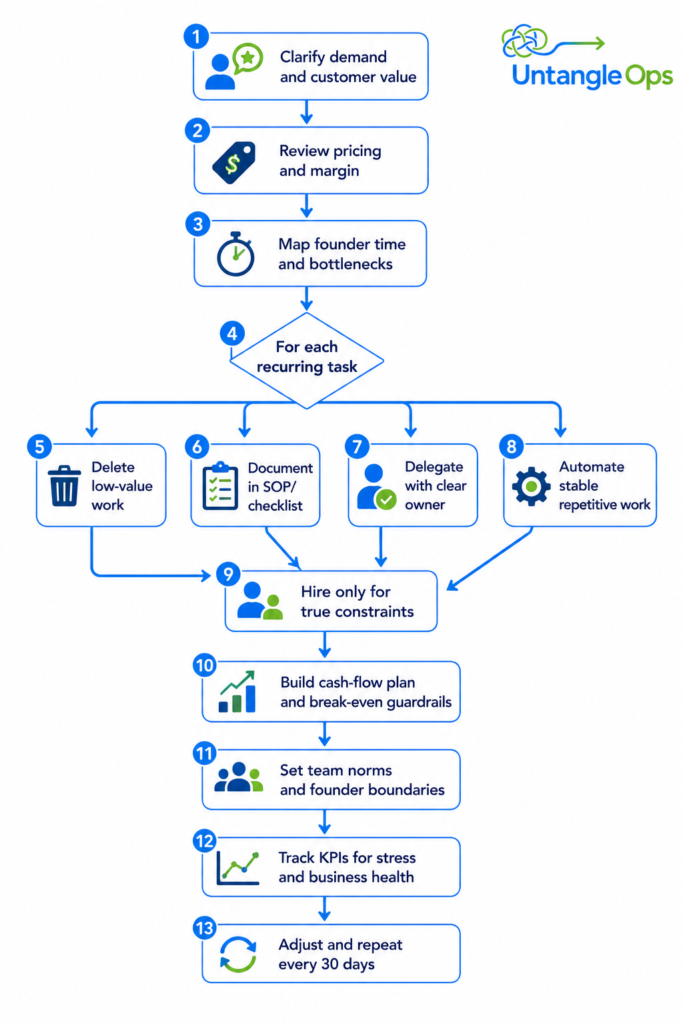
Sustainable-scaling process
A healthy scaling process is not linear forever, but it should be disciplined. The sequence below reflects the strongest patterns in the research: redesign work first, then expand capacity, then review stress and business-health metrics before repeating the cycle. [18]
What this looks like in real businesses
A useful example is 37signals, the company behind Basecamp. In its public handbook, the company says it limits itself to a 40-hour workweek and 32-hour summer weeks because the constraint forces prioritization. Whether or not an SMB copies that exact schedule, the underlying principle is powerful: if you protect time, you are forced to decide what matters. [19]
Wildbit offers a similar lesson. The company has publicly described itself as self-funded, profitable, remote since 2000, and committed to people-first operations. Its public employer profile says the team works four-day, 32-hour weeks, with flexibility built around life rather than constant presence. Again, the underlying lesson is not “every business must close on Fridays.” It is that sustainable growth depends on designing work so the business can perform without constant depletion. [20]
Aeolidia, a Shopify-focused design firm in the U.S. and Canada, is a more directly SMB-scaled example. In a 4 Day Week Global case study, the firm said it adopted a four-day week to improve recruitment and retention and reduce burnout. It reported that productivity stayed at pre-trial levels while profitability and utilization remained strong, and the founder noted a substantial increase in job applications. Across the wider UK pilot studied by Cambridge researchers, participating organizations reported lower burnout, lower stress, fewer sick days, and lower staff attrition, while many firms maintained or improved results by cutting meetings, creating focus periods, improving email habits, and redesigning handoffs. These examples lean toward knowledge-work firms, so implementation details differ by industry, but the transferable lesson is clear: sustainable scaling relies on work redesign, not founder heroics. [21]
Templates, scorecards, and resources
The tables below are practical templates built from the evidence above: SBA guidance on hiring and finance, OPM’s research-backed advice on structured interviews, role-clarity guidance from RACI, and burnout research emphasizing workload design, recovery, and meaningfully reduced friction. [22]
| Delegation model | Best use case | How it works | Main risk |
| Direct task delegation | One-off work with a clear deadline | Assign one owner, one outcome, one due date | Founder keeps all decisions |
| SOP and checklist delegation | Recurring work such as invoicing, scheduling, onboarding, reporting | Document steps, quality standard, escalation rules, and review cadence | Bad process gets repeated faster |
| RACI delegation | Cross-functional work such as launches, hiring, client delivery, tech changes | Clarify who is Responsible, Accountable, Consulted, and Informed | Too many people marked as “consulted” slows decisions |
A RACI model is most useful when work crosses functions and ownership has become fuzzy. [12]
| Hiring checklist | What to decide before posting the role | Beginner-friendly test |
| Bottleneck | What problem must this hire remove? | Will this hire free at least 5–10 owner hours a week or unlock revenue/service quality? |
| Outcomes | What must be true by day 90? | Can you name three concrete outcomes in one sentence each? |
| Scorecard | What skills and behaviors matter most? | Are you scoring candidates against the same criteria every time? |
| Structured interview | What questions will every candidate answer? | Are you asking the same core questions in the same order? |
| Work sample | What realistic task proves fit? | Can the candidate show how they would actually do the job? |
| Onboarding | What training, SOPs, and check-ins will they get? | Is week one already mapped before the person starts? |
| Compliance | Payroll, classification, contracts, and labor-law basics | Is the admin complete before day one? |
| Delegation matrix | Keep with founder | Delegate now | Automate now | Delete now |
| Tasks requiring founder judgment, relationships, or final accountability | Vision, key partnerships, hiring decisions, high-stakes pricing | Scheduling, invoicing, first-line customer support, bookkeeping prep, reporting | Meeting notes, reminders, data entry, draft follow-ups, basic dashboards | Duplicate meetings, vanity reports, approvals nobody uses, low-value admin |
| Ninety-day scaling plan | What to do |
| First 30 days | Audit founder time; list every recurring task; review demand, margins, and pricing; identify one bottleneck; set baseline metrics for owner hours, sleep, energy, cash buffer, gross margin, and on-time delivery. |
| Next 30 days | Write SOPs for the top three recurring tasks; implement one RACI chart for a messy process; redesign meetings; pilot one automation; post one targeted hire only if the bottleneck truly needs a person. |
| Final 30 days | Onboard or delegate; review KPI trends weekly; raise or simplify pricing if margin is still thin; decide what stays off the founder’s plate permanently; document the next bottleneck and repeat. |
| KPI | Why it matters | Healthy direction |
| Founder weekly hours | Direct stress-load proxy | Stable or falling |
| Nights worked after hours | Boundary proxy | Falling |
| Average sleep | Recovery proxy | At or above 7 hours |
| Founder energy score | Early burnout signal | Stable or improving |
| Cash buffer days | Shock tolerance | Rising |
| Gross margin | Protects capacity and hiring ability | Stable or rising |
| Days sales outstanding | Tells you whether growth is turning into cash | Stable or falling |
| Owner-dependent revenue share | Measures whether the company can scale without you | Falling |
| On-time delivery or service quality | Prevents “growth by chaos” | Stable or improving |
| Employee turnover or absenteeism | Culture and workload signal | Stable or falling |
| Customer retention | Shows whether growth is healthy, not leaky | Stable or rising |
These are practical proxies rather than universal clinical measures, but they line up well with the evidence on exhaustion, recovery, time pressure, and financial fragility. [23]
| Common pitfall | Why it backfires | Better move |
| Hiring before clarifying the bottleneck | Adds payroll without removing founder load | Define the exact constraint first |
| Delegating tasks but not decision rights | Work still bounces back to the owner | Delegate outcomes, limits, and escalation rules |
| Underpricing to win more work | Revenue grows while stress and delivery risk rise | Review price against value and margin |
| Automating a messy process | Turns confusion into faster confusion | Simplify and document before automating |
| Approving everything personally | Owner becomes the queue | Set approval thresholds and exceptions |
| Ignoring cash because revenue looks good | Growth becomes fragile | Track cash buffer, margin, and collections |
| Treating self-care as optional | Recovery never happens “later” | Put sleep, exercise, and downtime on the calendar now |
For further reading, the most useful beginner resources are often the most practical: Rework and It Doesn’t Have to Be Crazy at Work for operating philosophy; Profit First for margin and cash discipline; WHO’s mental-health-at-work guidance for structural prevention; the Federal Reserve’s Small Business Credit Survey for real SMB constraints; SBA’s finance, hiring, learning, and break-even resources for practical implementation; Atlassian’s RACI guide for role clarity; and the Cambridge/Boston College four-day-week research for examples of work redesign that improved well-being without a collapse in performance. [24]
Open questions and limitations. The strongest public case studies on sustainable scaling tend to come from service, software, and agency businesses, where meetings, handoffs, and calendar design are large productivity levers. Retail, hospitality, field services, and manufacturing can still use the same principles, but they often need staggered staffing, stronger scheduling discipline, and process redesign rather than a one-size-fits-all shorter week. [25]
Complete our Comprehensive Checklist Here
Selected sources and References
- World Health Organization. Burn-out an occupational phenomenon. [3]
- World Health Organization. Mental health at work and Guidelines on mental health at work. [26]
- Mayo Clinic. Job burnout: How to spot it and take action. [4]
- Stephan, U. Entrepreneurs’ mental health and well-being: A review and research agenda. Academy of Management Perspectives (2018). [27]
- Le Moal, M., Thurik, R., Torrès, O., and Soenen, G. Mental health of entrepreneurs and daily recovery experiences. Small Business Economics (2026). [28]
- Fernet, C., Torrès, O., Austin, S., and St-Pierre, J. The psychological costs of owning and managing an SME. Journal of Business Venturing Insights (2016). [29]
- Bes, I. et al. Organizational interventions and occupational burnout: a meta-analysis with focus on exhaustion (2023). [30]
- Federal Reserve Banks. 2026 Report on Employer Firms: Findings from the 2025 Small Business Credit Survey. [31]
- BDC. Mental Health and Productivity of Entrepreneurs Under Pressure Amid High Uncertainty: BDC Survey (2025). [9]
- JPMorgan Chase Institute. For Small Businesses: Cash is King. [32]
- CDC. About Sleep; NIOSH. Shiftwork, Long Work Hours, Fatigue. [33]
- World Health Organization. Physical activity and Anxiety disorders. [34]
- Vonderlin, R. et al. Mindfulness-based programmes in the workplace: a meta-analysis of randomized controlled trials (2020); Janssen, M. et al. Effects of Mindfulness-Based Stress Reduction on employees’ mental health (2018). [35]
- U.S. Office of Personnel Management. Structured Interviews. [36]
- U.S. Small Business Administration. Manage your finances; Hire and manage employees; AI for small business; Break-even point calculator; SBA Learning Platform. [37]
- Atlassian. Understanding and using RACI charts. [12]
- 37signals. How We Work. [19]
- Wildbit. Building a people-first business and employer profile. [20]
- 4 Day Week Global. Case study of Aeolidia. [38]
- University of Cambridge. Would you prefer a four-day working week? and Boston College. A four-day work week? [39]
Tags:
How to scale a business without burning out
Growing a business without hiring more managers
Operational challenges in growing businesses
Scale a business without burnout
Business growth challenges
Small business scaling
Operational scalability
Business architecture
Operational efficiency
Process improvement
Growing business operations
Business transformation
Scaling operations
Published On: 16 June, 2026
Written By: UntangeOps Specialist Team
Let’s Untangle YOUR Operations
We have a proven methodology and can replicate our success for your organization. Easy.