
Preparing Your Business to Perform Beyond the Current Owner
What Buyers Look for in Businesses for sale
Executive Summary
If you are thinking about selling your business in the next few years, you have probably wondered what it is worth. But there is another question that is just as important:
What will a buyer actually see when they look inside the business?
A profitable company can still be difficult to sell if it depends heavily on the owner, has poorly documented processes, unreliable reporting, outdated systems, or important knowledge that exists only in employees’ heads. Conversely, a business that is well organized and understandable is much easier for a prospective buyer to evaluate. Buyers want confidence that customers will stay, employees can continue doing their jobs, cash will keep flowing, and the business will function after the current owner leaves. This matters particularly now. BDC reported in 2026 that nearly one in five Canadian companies plans to exit within the next five years, putting more than $300 billion in business revenue in play. Many owners, however, have not adequately prepared for the transition. [1]
For an owner approaching retirement, operational preparation should therefore start well before the business goes on the market. The goal is not to make the company look perfect. The goal is to make it understandable, transferable and credible.
Selling a Business Is About More Than the Financial Statements
Imagine two businesses. Both generate similar revenue. Both have been profitable for years. Both have loyal customers and experienced employees.
In the first company, the owner approves most purchases, handles important customer relationships, resolves difficult employee issues and knows how pricing works because “that’s how we’ve always done it.” Several important processes are undocumented. Reports are assembled manually, and a few spreadsheets contain information nobody else fully understands.
In the second company, responsibilities are reasonably clear. Customer and supplier information is organized. Employees understand how important work gets done. Financial and operational reports are readily available. The owner remains important, but the company can function without them being involved in every decision.
From the owner’s perspective, these may both be good businesses. From a buyer’s perspective, they are very different investments. The first business contains transition risk. The second offers greater operational confidence. And buyers pay close attention to that difference.
BDC describes due diligence as a critical part of buying a business because it allows buyers to verify the company’s prospects, finances and risks before completing the acquisition. Information discovered during due diligence can affect valuation, deal terms or even cause a buyer to walk away. [2]
That is why preparing a business for sale should not begin when somebody asks to see the financial statements. It should begin with making the business easier to understand.
What Buyers Are Really Trying to Determine
A buyer looking at your operations is ultimately trying to answer a simple question:
Can this business continue to perform after the current owner leaves?
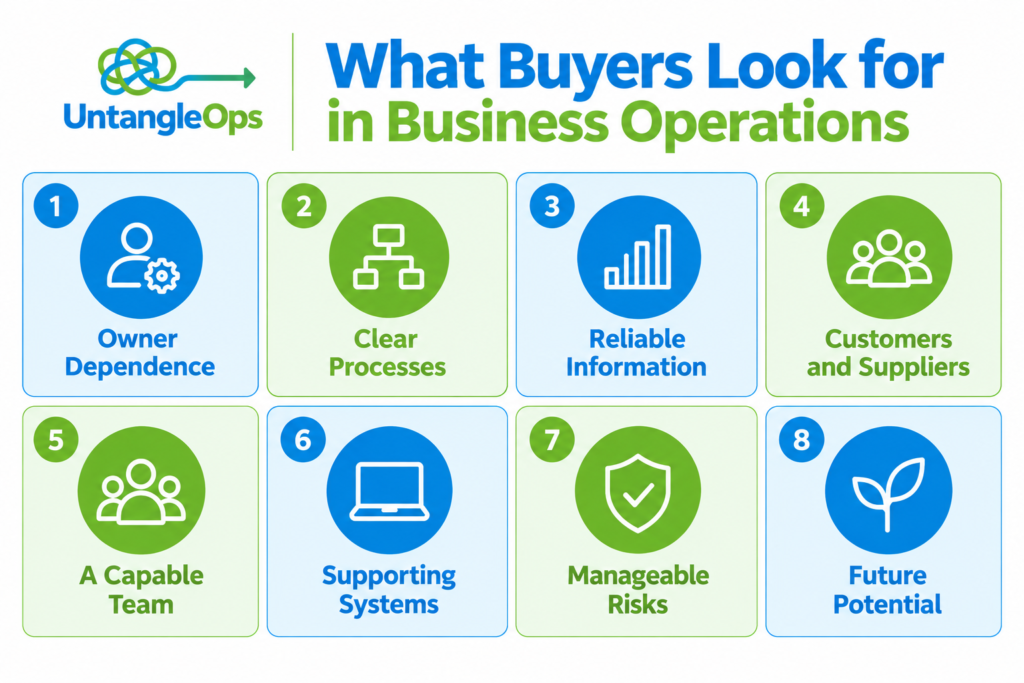
Almost everything else flows from that. Here are some of the operational areas a serious buyer is likely to examine.
1. How Dependent Is the Business on the Owner?
For many private businesses, this is the biggest issue. Owners who have spent 20, 30 or 40 years building a company naturally become central to it. You may know every major customer. You may negotiate with suppliers. Employees may come to you whenever something unusual happens. You may approve pricing, hiring, purchasing and large expenses. You may even know which customer needs a phone call on Friday afternoon because nobody else realizes their order is becoming a problem. That knowledge is valuable.
But to a buyer, excessive dependence on the owner creates risk. The buyer has to ask:
What happens when this person is no longer here?
A business does not need to operate without its owner before it can be sold. That is unrealistic for many small companies. But there should be a credible path for transferring the owner’s responsibilities.
A simple owner-dependency test
Ask yourself: If I disappeared from the business for 30 days, what would stop working? Write down everything that comes to mind. Pricing approvals. Customer relationships. Payroll questions. Purchasing. Scheduling. Supplier negotiations. Hiring. Banking. Troubleshooting. Sales. That list is effectively a map of your owner-dependency risk. For an owner preparing to sell, reducing that list can be one of the most useful things you do before going to market.
2. Are the Business Processes Understandable?
Buyers do not expect a 50-person company to have a 500-page corporate procedure manual. They do, however, want to understand how the business works.
- How does a new customer become an active customer?
- How is an order received, fulfilled and invoiced?
- How are prices determined?
- How are customer complaints handled?
- How does purchasing work?
- How are employees trained?
- How does management know whether the business is performing properly?
If the answer to most questions is: “You need to ask John.” or: “Susan has a spreadsheet for that.” the buyer sees risk. A well-prepared company can explain its most important workflows simply. That does not mean documenting everything.
Start with the processes that directly affect:
- Revenue
- Customers
- Cash
- Quality
- Employees
- Suppliers
- Regulatory obligations
- Business continuity
A buyer wants to see a business, not a collection of individual habits.
3. Can the Buyer Trust the Numbers?
Financial statements are obviously important in any transaction. But sophisticated buyers will usually look beyond the income statement. They want to understand what drives the numbers.
For example:
Revenue increased 12%. Why? Margins declined. Why? One customer represents 25% of sales. Is that relationship secure? Overtime increased significantly. Is there a capacity problem? Inventory has grown faster than revenue. Is it usable inventory? Sales look healthy, but receivables are climbing. Why?
This is where operational reporting becomes important. A buyer gains confidence when management can connect financial results to what is actually happening inside the company. Depending on the business, useful operating measures might include:
Sales → Orders → Backlog → Delivery → Gross Margin → Cash Collection
The exact measures are less important than consistency. If every question requires somebody to create a new spreadsheet and spend three days reconciling numbers, the buyer may start wondering what else is difficult to see.
4. How Concentrated Are the Customer Relationships?
A company can be profitable and still carry significant customer risk. Imagine that your largest customer represents 35% of revenue. That may have been a wonderful relationship for 15 years. But a buyer will ask:
- Who owns the relationship?
- Is there a contract?
- How easily could the customer leave?
- Does the customer buy because of the company or because of the owner personally?
- When was pricing last negotiated?
- Are several people connected to the account, or does everything run through one relationship?
The same issue applies to suppliers. If one supplier is essential to production or service delivery, a buyer will want to understand the dependency.
Preparing for sale therefore means looking at concentration from both directions:
Who do we depend on to generate revenue, and who do we depend on to deliver it?
5. Is There a Team That Can Run the Business?
Employees are often one of the most valuable parts of an established private company. They can also represent significant transition risk. A buyer will want to understand:
- Who are the key employees?
- Who manages day-to-day operations?
- Which people hold critical knowledge?
- Are roles clearly defined?
- Are employment agreements and compensation arrangements documented?
- Who might leave when ownership changes?
- Who could take on more responsibility?
This becomes particularly important when a long-time owner has informally served as general manager, sales director, operations manager and chief problem solver. A buyer does not necessarily need a large management team. They need confidence that the people who remain can operate the company.
6. Are the Systems Helping or Holding the Business Together?
Technology is increasingly part of acquisition due diligence, even in relatively traditional businesses. A 30-year-old manufacturing, distribution, construction or professional-services company may now depend on accounting software, ERP systems, CRM platforms, scheduling applications, cloud storage, payroll systems and dozens of spreadsheets.
A buyer may ask:
- What systems does the business depend on?
- Who owns the accounts and administrative access?
- Are software licences current?
- Where is business data stored?
- Are backups in place?
- Are important systems integrated or does information have to be manually re-entered?
- Does the company depend on custom spreadsheets or software maintained by one person?
- How difficult would these systems be to transfer to new ownership?
The objective is not necessarily to replace older technology before selling. In fact, launching a major software implementation immediately before a sale can create unnecessary risk. The priority is to understand what you have, document it and address serious vulnerabilities.
Thinking About Selling in the Next Few Years?
You do not need to have a buyer lined up before preparing your operations. In fact, the best time to begin is usually before a transaction is on the table.
UntangleOps helps private business owners assess their operations from a buyer’s perspective and identify practical improvements that can make the company easier to understand, manage and transfer.
We can help evaluate:
- Owner dependency
- Business processes and operational maturity
- Management roles and organizational structure
- Operational reporting and KPIs
- Systems and technology
- Customer and supplier dependencies
- Documentation and knowledge transfer
- Operational risks likely to emerge during due diligence
- Transition readiness
We also support prospective buyers by assessing the operational side of acquisition targets—helping determine what is working, where risks are hidden, what investment may be required after closing, and whether the business can realistically operate and grow under new ownership.
Whether you are preparing to pass on the business you spent decades building or considering buying one from somebody who did, the objective is the same: understand how the business really works before the transaction happens.
Selected sources and References
- [1] Business Development Bank of Canada (BDC), Many entrepreneurs are ready to pass the torch, but few are prepared, August 12, 2026.
- [2] Business Development Bank of Canada (BDC), How to conduct due diligence when buying a business, updated November 24, 2025.
- [3] Business Development Bank of Canada (BDC), How to plan your exit from your business.
- [4] Business Development Bank of Canada (BDC), Finding your match when buying or selling a business, January 28, 2026.
- [5] Canadian Federation of Independent Business (CFIB), Succession planning: Verifying the buyer.
Tags:
Selling a Business Ontario
Preparing a Business for Sale
Business Succession Planning
Operational Due Diligence
Buying a Business Ontario
Business Exit Planning
Owner Dependency
Business Valuation Preparation
Small Business Succession
Business Acquisition
Operational Readiness
Retirement Business Planning
Written By: UntangeOps Specialist Team
Published On: 15 September, 2026
Let’s Untangle YOUR Operations
We have a proven methodology and can replicate our success for your organization. Easy.