
Growing Business Challenges – Systems
When Is the Right Time to Invest in Better Systems?
Executive Summary
The right time to invest in better systems is usually after operational friction becomes repeatable and measurable, but before it becomes a credibility problem. In practice, that means moving when the same bottlenecks keep reappearing across handoffs, staff are building spreadsheet workarounds, management spends too much time reconciling data, month-end reporting is too slow for decision-making, or customer and compliance risks are starting to climb. Recent shows that many SMEs are still only partly mature digitally, and that the main barriers are not just buying tools but also maintenance costs, training time, hardware costs, skills, and the need to adapt business processes. The technology literature reaches the same conclusion from a different angle: digital tools create the most value when they are combined with organizational redesign, process changes, and workforce capability building—not when software is treated as a stand-alone fix. [1]
For SMB owners and managers, the practical implication is straightforward: buy systems later than many vendors suggest, but earlier than many operators are comfortable admitting they need them. The best first investment is often not a full suite; it is clearer process ownership, cleaner master data, explicit exception handling, and a narrowly scoped tool that removes one or two expensive bottlenecks. That sequencing matters because recent SME research emphasizes skill gaps, resistance to change, and legacy reliance as major obstacles, while seminal work on data quality and process redesign shows that poor process logic and poor data do not disappear when digitized—they become harder to see and faster to spread. [2]
A useful rule is this: if your business problem is still mainly ambiguity, fix the work before you buy software; if it has become mainly coordination at scale, buy carefully scoped software once the foundations are in place. The rest of this report turns that rule into an SMB-oriented maturity framework, decision triggers, procurement guidance, and a practical flowchart. [3]
When the timing is actually right
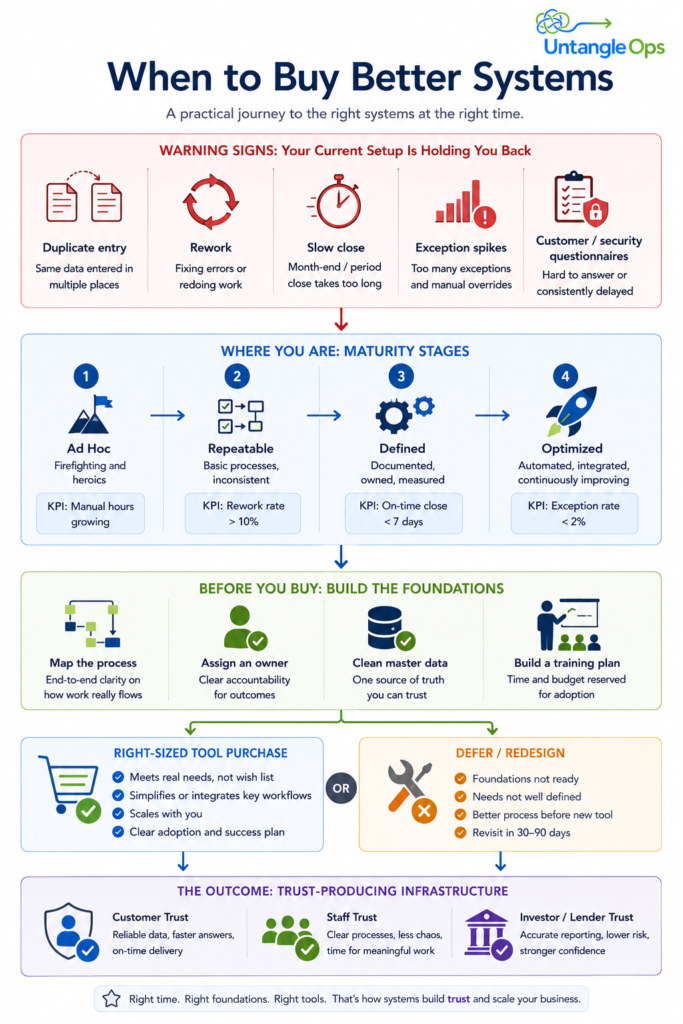
The timing is right when operational pain stops being episodic and starts being structural. That usually shows up as familiar symptoms: duplicate entry across functions, recurring reconciliation work, slow or unreliable reporting, rising exception handling, more customer-facing misses, and growing dependence on a few people who “just know how things work.” Research on enterprise-system misfit shows that when formal systems do not match real work, employees create persistent workarounds to keep value flowing. Public-company disclosures and enforcement cases show the larger-scale version of the same mechanism: process/control misalignment around system changes can impair order fulfillment, reporting, and incident response. [4]
A second sign is that the business can no longer absorb complexity through effort alone. The 2025 OECD D4SME survey found that only about half of surveyed SMEs ranked as “competent” or better in digital maturity, with many still clustered in basic or uneven adoption. The same survey found the top barriers were maintenance costs, lack of time for training, and hardware costs; skill development was often informal rather than structured. That matters because it means the decision is not simply “buy or don’t buy.” It is “buy only when you can also afford the process, training, and governance work around the tool.” [5]
A third sign is that trust-sensitive stakeholders are starting to notice the cracks. If customers ask for clearer order status, service consistency, audit trails, or security assurances; if staff say roles are unclear or the tools are getting in the way of doing the job right; or if lenders, directors, or investors start pushing for faster, more reliable reporting, the issue is no longer just efficiency. It has become a credibility issue. Official control-and-assurance frameworks are explicit that reliable systems require security, availability, processing integrity, logging, retention, and internal controls—none of which appear automatically just because software has been installed. [6]
The timing is not right when the core workflow still changes every week, nobody agrees on the “one right way” to handle normal cases and exceptions, or the team cannot spare time for training and stabilization. Digital-transformation research consistently frames the problem as organizational change, not mere tool deployment; SME case research adds that employee capabilities can be both an enabler and a constraint. In other words, if the business is still inventing the process, software will usually freeze confusion into the operating model. [7]
An SMB operational maturity model
The framework below is an SMB-adapted synthesis rather than a formal standard. It is designed to answer a question many generic maturity models do not answer well enough for smaller firms: “What should I do next, and what should I delay?” The stages reflect BPM maturity literature, recent SME digital-transformation findings, and the general logic of moving from ad hoc practice to repeatable and adaptive management. The KPI bands and triggers are practical heuristics, not universal benchmarks. [8]
| Maturity stage | Typical operating pattern | KPIs to watch | Decision trigger | Recommended action |
| Reactive | Founder- or manager-carried operations; handoffs live in inboxes and spreadsheets; exceptions dominate; reporting is manual | Monthly close days; rework/error rate; % of transactions rekeyed; backlog age; single-person dependency | The same exceptions recur weekly; reporting cadence lags decisions; one absence materially disrupts service | Do not start with a full suite. Map the top 3 workflows, define owners, standardize normal vs exception paths, stabilize master data, and instrument a few core KPIs |
| Defined | Core workflows are documented; teams mostly agree on the standard path; data fields and approvals are clearer, but systems are still fragmented | First-pass yield; on-time fulfillment/service; data completeness; response time; training completion/adoption | Two or more functions maintain duplicate records; close is still too slow; customer updates require manual reconciliation | Add narrowly scoped workflow, CRM, inventory, ticketing, or finance software where the process is now stable; prefer configuration over customization |
| Integrated | Core functions share common records; reporting is more timely; controls are more repeatable; fewer heroic workarounds | End-to-end cycle time; exception rate; forecast accuracy; DSO/cash conversion; inventory or case accuracy | Growth in channels, locations, entities, or regulatory requirements increases coordination burden faster than staff capacity | Expand integration and automation between systems; strengthen access controls, audit logs, retention rules, and reporting discipline; use APIs before replacing everything |
| Scaled | Processes are auditable, roles are clear, and systems support external scrutiny; the business is preparing for larger counterparties, diligence, or multi-entity complexity | Multi-entity close days; customer questionnaire turnaround; onboarding time; control test pass rate; uptime/recovery performance | Client, investor, or regulatory demands exceed the capabilities of modular tooling; reporting and control requirements become enterprise-like | Upgrade only the areas that truly need suite-level capabilities; consider robust ERP/private/on-prem/hybrid options only if complexity, sovereignty, customization, or uptime requirements justify them |
If a company cannot reliably measure even the first column of KPIs, that is itself evidence that it is still in the Reactive stage and should invest first in operating discipline, not software breadth. BPM maturity research is useful for diagnosis, but even the academic review literature notes that maturity models often provide limited prescriptive guidance. That is why an SMB-friendly model should tie each stage to a next move and a clear “not yet.” [9]
What should happen before software
Before buying software, the business should make the work visible. The most practical step is a current-state process map of the top revenue, fulfillment, and cash workflows, built with the people who actually do the work, not just managers who describe it from memory. The is blunt on this point: maps are useful when they show the process as it really happens, include tasks and people, and go to the level at which quality issues can actually be identified and corrected. The remains useful because it creates a common way for business users and implementers to describe the same workflow. [10]
Next comes role clarity. Each critical process needs, at minimum, a process owner, a data owner for core records, and an exception owner for when the normal path breaks. This is not bureaucracy; it is what prevents software from becoming a sophisticated container for unresolved arguments. Gallup’s long-running engagement work is relevant here: employees who strongly agree that they know what is expected of them are materially more likely to be engaged, and clearer expectations are linked to better turnover, safety, and productivity outcomes. Better systems work best when they reinforce that clarity rather than substitute for it. [11]
Then comes data hygiene. Seminal data-quality research shows that data quality is not just accuracy; it also includes completeness, timeliness, interpretability, consistency, accessibility, and fit for use. More recent review work in industrial settings reinforces that data quality has to be designed deliberately and managed as a sociotechnical issue, because decisions and risk management increasingly depend on heterogeneous operational data. For SMBs, that translates into concrete basics: one customer ID, one product/service code, one definition of “booked,” one owner for each critical field, explicit deduplication rules, and retention rules that survive staff turnover. [12]
Finally, make change management real enough to survive contact with daily work. Recent SME studies find that skills gaps, resistance to change, and reliance on legacy systems are common obstacles, and the broader digital-transformation literature emphasizes continuous adaptation rather than one-time implementation. In practical terms, that means defining the case for change, protecting training time, piloting before scaling, measuring adoption rather than just go-live, and deciding in advance what will be retired, what will run in parallel temporarily, and what “success after 90 days” looks like. [13]
Why software alone does not fix bad processes
The core reason is complementarity. Research from the productivity literature shows that digital technologies typically require substantial complementary investments in new processes, managerial experience, training, and other intangibles; firm-level work also finds that ICT investment and organizational innovation are complementary, with joint investment producing better productivity outcomes than isolated spending on technology. In plain language, the software license is only part of the investment. The real value comes from redesigning the work around it. [14]
That is why Michael Hammer’s old warning still matters: companies rarely get radical gains by using computers to speed up outdated work. If the approval path is bloated, if customer onboarding is missing ownership, or if order fulfillment is full of avoidable exceptions, digitizing the existing flow often just makes the defects faster, more consistent, and harder to override. The software looks disciplined; the operation is still weak. [15]
Poor data creates a second failure mechanism. Once bad IDs, ambiguous statuses, or inconsistent definitions enter an integrated system, the problem is no longer isolated in one spreadsheet. It propagates across planning, billing, inventory, service, and reporting. Data-quality research is clear that fitness for use includes contextual and representational properties as well as correctness. In SMB settings, this is why “we’ll clean it up after go-live” is usually a costly fantasy. [12]
A third mechanism is process-package misfit. When the real workflow and the software model diverge, employees invent workarounds: spreadsheets, manual side channels, duplicate records, or shadow approvals. Research on enterprise-system workarounds shows these adaptations can persist because they help people get the work done under local realities, but they also fragment control, hide risk, and undercut the supposed “single source of truth.” [16]
The public-company cases are bigger than most SMBs, but the mechanisms transfer cleanly. In one SEC-filed example, an ERP launch disrupted manufacturing and shipment fulfillment, contributed to a disclosed material weakness in internal control over financial reporting, and was associated with roughly $64 million in unfulfilled shipments and more than $53 million in remediation-related charges. In an SEC enforcement action against a trading firm, the regulator found that inadequate software controls and weak response procedures allowed a malfunctioning system to reach the market without adequate safeguards. In a separate SEC matter, ERP implementation issues and internal-control weaknesses became serious enough that investors pressed the issuer over delayed financial results. SMBs rarely experience these failures at that scale, but they absolutely experience the same chain: bad process fit, weak controls, poor response readiness, and damage to service credibility. [17]
How to avoid overbuying
The simplest anti-overbuy principle is this: buy for the next order of magnitude of complexity, not the one after that. OECD evidence shows SMEs remain constrained by maintenance cost, training time, skills, and process adaptation, while SME case research emphasizes human capability and cautious, sustainable adoption. That argues against buying enterprise-scale architecture to solve an upper-middle-market problem that has not arrived yet. [18]
![flowchart TD A[Recurring operational pain?] -->|No| B[Keep current tools and instrument baseline KPIs] A -->|Yes| C[Map current process, assign owner, clean master data, reserve training time] C --> D{Foundations complete?} D -->|No| E[Do foundations first] D -->|Yes| F{Can current tools be simplified, standardized, or integrated?} F -->|Yes| G[Pilot low-cost fixes] F -->|No| H{Does the need span multiple critical workflows or entities?} H -->|No| I[Choose focused SaaS or module and pilot one workflow] H -->|Yes| J{Need strict sovereignty, offline/low-latency use, or unusual customization?} J -->|No| K[Choose modular SaaS suite with open APIs and export] J -->|Yes| L[Evaluate private, hybrid, or on-prem only with strong IT ownership] G --> M{Payback and risk reduction acceptable?} I --> M K --> M L --> M M -->|No| N[Redesign process, narrow scope, or defer] M -->|Yes| O[Phased rollout with adoption metrics, rollback plan, and exit terms]](https://untangleops.com/wp-content/uploads/2026/06/whentobuysoftware-683x1024.png)
The logic behind the flowchart reflects three consistent themes in the literature and official guidance: technology value depends on complementary process and organizational changes; cloud and software selections must be assessed before authorization, not after; and organizations should pursue risk reduction in ways that are feasible and cost-effective for their size and maturity. [19]
| Deployment posture | Usually the better fit when… | Main watch-outs |
| SaaS / cloud | You want faster deployment, lower infrastructure burden, easier remote access, and SMB-scale administration | Data residency, role design, logging, retention, API/export rights, incident disclosure, vendor lock-in, and the fact that security responsibilities are shared rather than transferred |
| On-prem / private / hybrid | You have strict sovereignty or connectivity constraints, unusual customization, low-latency/offline requirements, or non-negotiable contractual/regulatory conditions cloud vendors cannot meet | You own much more of patching, backup, access control, continuous monitoring, resilience, staffing, and lifecycle cost |
Official guidance is unambiguous on the main point: cloud services are attractive because they are scalable and on-demand, but security, privacy, authorization, and contract terms must be assessed up front; the consumer still owns significant responsibilities, especially around data and access. Contracts should specify data location, activity-log access, incident notifications, retention/destruction, patching expectations, and clear responsibilities across the provider and customer. [20]
A practical procurement checklist for SMBs is short and strict. First, test workflow fit against the top five recurring jobs-to-be-done and their exceptions, not the vendor’s generic demo path. Second, require proof that the tool can support your access model, audit/logging needs, and data-retention expectations. Third, verify import/export and API practicality before signing, because data egress and switching costs are part of TCO whether or not they appear on the quote. Fourth, ask what percentage of your expected value depends on customization; if the answer is “a lot,” the process or product fit is probably wrong. Fifth, stage the rollout so that at least one core workflow delivers a measurable result within one management cycle. [21]
For cost-benefit discipline, the most useful SMB heuristics are managerial rather than academic. Prefer the smallest system that removes the most expensive recurring failure mode. Treat first-year total cost as including software, implementation, migration, training, dual-running, and management time. Prefer projects whose payback is visible inside roughly 12 to 18 months, and be skeptical of any business case in which more than about a third of expected value depends on heavy customization or “future-state” behaviors the team has never demonstrated. Those thresholds are not formal standards; they are practical guardrails consistent with the broader evidence that early returns depend on complementary investments and that late, reactive fixes become more expensive. [22]
The credibility effect
The “credibility effect” is the cumulative trust signal created by better systems. It is not about looking sophisticated. It is about stakeholders observing consistent fulfillment, cleaner reporting, clearer ownership, faster answers, visible controls, and fewer unpleasant surprises. This report uses the term as an inference from the evidence on assurance frameworks, internal controls, employee clarity, and operational reliability. [23]
With customers, credibility comes from predictability. A company that can show order status, hit promised dates, issue accurate invoices, answer audits or security questionnaires quickly, and demonstrate controls around security, availability, and processing integrity is easier to trust than one that relies on manual promises and after-the-fact cleanup. That is exactly why assurance frameworks such as SOC 2 are built around controls over security, availability, processing integrity, confidentiality, and privacy. Even if an SMB never pursues formal attestation, the same control logic improves customer confidence. [24]
With staff, credibility comes from clarity and competence. When employees know what is expected, have the systems and materials needed to do the job right, and see fewer contradictory records or shadow processes, management appears more trustworthy and the workplace becomes easier to navigate. Gallup’s evidence on expectations and tools is particularly relevant here, and recent SME research reinforces that leadership capability, digital know-how, and human-centric implementation practices are crucial to sustainable digital transition. [25]
With investors, lenders, and boards, credibility comes from reporting discipline and control readiness. The SEC’s rules and guidance are explicit that sound books, records, and internal accounting controls are fundamental to timely and accurate reporting. In real cases, system and control weaknesses have triggered material weaknesses, reporting stress, and investor concern. For private SMBs, the mechanism is usually less formal but highly recognizable in diligence: cleaner closes, defensible metrics, audit trails, and documented controls reduce perceived execution risk. [26]
Selected references and limitations
The evidence base here is strongest on SMEs broadly, business-process maturity, cloud/software control requirements, and large-company system failure mechanisms. It is less precise on universal KPI thresholds for all SMBs, because those vary materially by industry, working-capital model, regulatory burden, and service versus product operations. The maturity triggers and payback heuristics in this report are therefore practical decision aids, not standards. Larger-company failure cases were included to illustrate mechanisms that also apply to SMBs, not to imply identical risk magnitude. [27]
- OECD. 2026.
- OECD. 2025.
- André Hanelt, René Bohnsack, David Marz, and Cláudia Antunes Marante. 2021.
- Jose Antonio Clemente-Almendros, Dorina Nicoara-Popescu, and Ivan Pastor-Sanz. 2024.
- Sami Seppänen, Juhani Ukko, and Minna Saunila. 2025.
- Maximilian Röglinger, Jens Pöppelbuß, and Jörg Becker. 2012.
- U.S. Centers for Disease Control and Prevention. 2020.
- Object Management Group. 2010.
- Richard Y. Wang and Diane M. Strong. 1996.
- Qiong Fu. 2024.
- Erik Brynjolfsson, Daniel Rock, and Chad Syverson. 2020 revision of 2018 working paper.
- Pierre Mohnen, Michael Polder, and George van Leeuwen. 2018. urlICT, R&D and organizational innovation: Exploring complementarities in investment and productionturn21view1
- Robert M. Davison, et al. 2021.
- National Institute of Standards and Technology. 2011.
- National Institute of Standards and Technology. 2011.
- National Institute of Standards and Technology. 2020.
- National Institute of Standards and Technology. 2024.
- Canadian Centre for Cyber Security. 2024.
- Canadian Centre for Cyber Security. 2020.
- American Institute of CPAs. 2023.
- American Institute of CPAs. 2023.
- U.S. Securities and Exchange Commission.
- U.S. Securities and Exchange Commission. 2007.
- Gallup. 2026.
- Gallup. 2026.
- Public-company case example.
- SEC enforcement case example.
- SEC administrative order.
- Michael Hammer. 1990.
- John P. Kotter. 1995.
Tags:
Operational Scaling
Business Process Optimization
Systems Implementation
Business Technology
Operational Bottlenecks
Software Selection
ERP Implementation
Operations Management
Small Business Technology
Business Architecture
Written By: UntangeOps Specialist Team
Published On: 18 June, 2026
Let’s Untangle YOUR Operations
We have a proven methodology and can replicate our success for your organization. Easy.